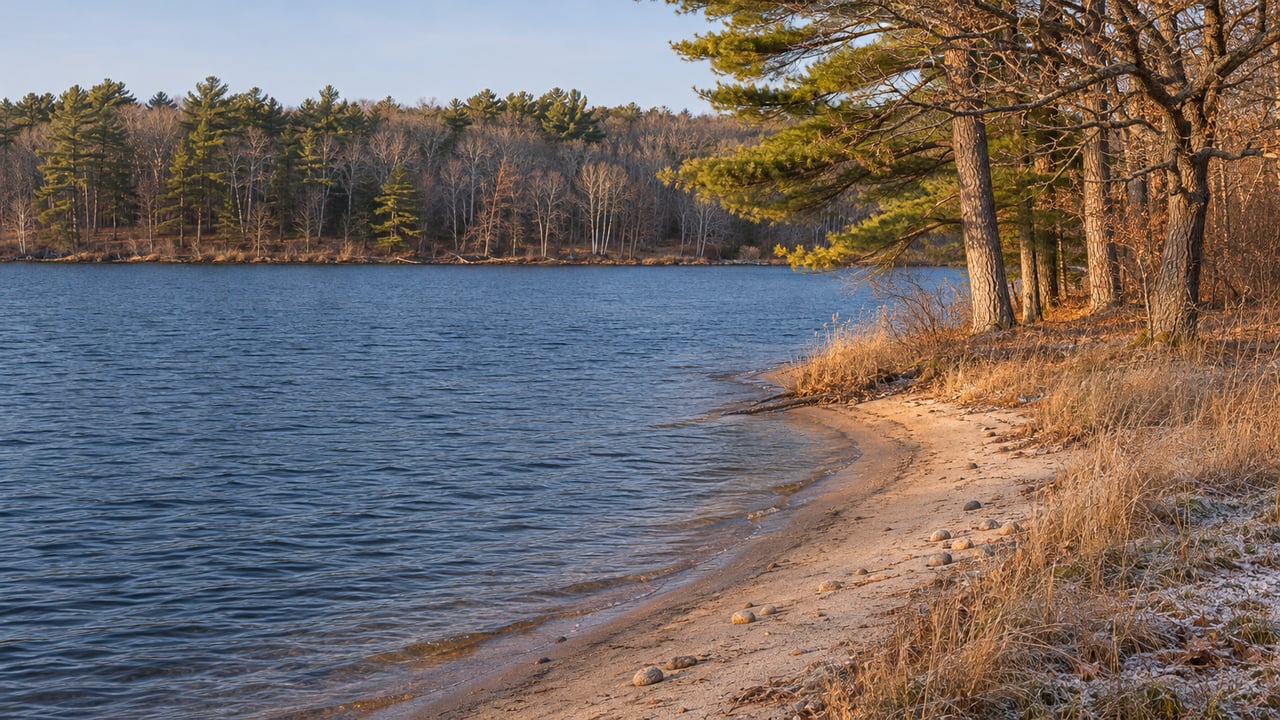
From mid-June through the end of January, Castle Rock Lake hardly moves. Wisconsin River Power Co. operates the dam and keeps the flowage within about a foot of its summer level between June 15 and February 1. So the lake you toured on a July Saturday looked almost exactly like it did in October. The dock reached the water and the bay looked deep enough. Whatever sits two or three feet below the surface stayed out of sight.
In February the lake drops. That drop is the main reason a buyer comparing lake homes near New Lisbon should keep searching through the winter. The off-season is the one time of year these flowages show you their frontage. It is also when Juneau and Adams counties have the most room to negotiate, because both went into this winter with more months of supply than Wisconsin as a whole.
Thanksgiving through January: the lake looks like it does in summer
On Thanksgiving week, Castle Rock and Petenwell sit at their normal level. A showing now gives you the same view a summer buyer got, plus bare trees. Bare trees help more than you'd expect. With the leaves down you can see the sightlines to neighbors, the slope from the house to the water, and how the lot sits against the shoreline.
You still can't see the bottom. Wisconsin River Power describes both flowages as fairly shallow, with depths and bottom conditions that vary from place to place. On Castle Rock, the company says shallows can hide in unexpected spots, even far from shore. It names the northern parts of the Wisconsin River and Yellow River arms, plus the west shore south of the railroad bridge, as areas with shallow, stumpy water. If the place you're looking at is in one of those reaches, your list of questions will look different from a buyer's on the main body of the lake.
Use these weeks to narrow the list. Tour the homes, write down which frontages you can't judge from the dock, and plan to come back.
February into April: the drawdown
Each year, Wisconsin River Power lowers both reservoirs in late winter to make room for spring runoff from melting snow in northern and central Wisconsin. The drawdown also adds winter power generation. In a normal year the drawdown starts in February, and how far it goes depends on how much water is in the snowpack up north.
Last winter started early. The company announced in January 2026 that it would begin lowering Petenwell on Monday, January 19, and Castle Rock on Sunday, February 1. It moved the schedule up so it could do maintenance work at Castle Rock Dam. It also said levels could fall by up to 5 feet at Petenwell and up to 6 feet at Castle Rock.
Six feet changes what a showing tells you. A summer shoreline you couldn't evaluate becomes one you can walk along and look at from the bank. How far the shallow water runs out in front of the lot, what the bottom looks like where the dock goes in, and whether stumps sit in the path a boat would take from the lift to open water all come into view. Those are the things a July buyer takes on faith.
Look from land. The same 2026 notice warns that a drawdown can leave thin or unstable ice, and it tells people to stay off the ice with snowmobiles and vehicles and to watch for fast-changing water. A late-winter showing is a walk along the bank and the yard, never a walk out onto the bay.
Timing matters, and it changes every year. Wisconsin River Power posts current reservoir levels and river flows on its website under "Hydroelectric Project Data." Check it before you book a second visit to a property, and aim for when the gauge is near its low.
Late March to May 1: the window closes
Refill usually starts in late March as the snow melts, and Wisconsin River Power brings Castle Rock back to its normal summer level by May 1. Petenwell follows the same pattern. In 2026 the company expected both reservoirs back to normal by the end of April.
That puts a spring buyer in a tight spot. Someone who starts looking in April sees the lake rising or already full, and by summer the water hides everything again until the next February. On these two flowages, a winter buyer can see the frontage that a summer buyer can't.
The county numbers say there's room to take your time
Seeing the frontage at low water only helps if you can afford to wait for it. In a fast market, a buyer can't hold off until February to look at the bottom. The latest county data from the Wisconsin REALTORS Association suggests Juneau and Adams counties aren't moving that fast.
Months of inventory is the measure to watch. WRA treats six months as a balanced market, and less than that favors sellers. Statewide, Wisconsin had 4.4 months of supply in August 2026. WRA called that a seller's advantage, with supply well below the balance point.
Here is what the two lake counties looked like a month later, in WRA's September 2026 report, published October 22, 2026.
| County, September 2026 | Months of inventory | Avg. days on market | Sales | Median sale price |
|---|---|---|---|---|
| Juneau | 6.2, down from 6.9 in Sept. 2025 | 76, down from 83 | 41 | $215,000 |
| Adams | 7.4, unchanged from Sept. 2025 | 98, down from 100 | 68 | $282,500 |
Both counties were at or above balance in September, the last month of the busy season, while most of the state stayed tight. WRA itself calls the months after summer the off-peak season. Average days on market ran 76 in Juneau and 98 in Adams in September 2026, so a typical listing in either county sat for more than two months before it sold. That's long enough for a buyer to see a place in December and come back once the water is down.
Read these numbers carefully. They cover all residential sales in each county, not only waterfront. WRA also notes that county sales and medians aren't seasonally adjusted and can be revised later. Single-month medians in counties this size also swing hard. Juneau's September median was down 19.1 percent from September 2025, yet its median for January through September 2026 was $265,900, up 11.3 percent from the same months of 2025. We covered why that happens in New Lisbon's Median Home Price Is a Trick Question. For a winter lake search, supply and days on market matter more than the median, and both point toward having time.
Putting the calendar together
A buyer who starts now has three stages. From late November through January, tour homes and narrow the list while the lake looks like it does in summer and the trees are bare. When the drawdown begins, usually in February, go back to the frontages you couldn't judge and look at them from the bank, with Wisconsin River Power's level data in hand. Then make offers on the places that still hold up once you've seen what was under the water, before refill in late March and before spring buyers show up.
Two other things belong on a winter visit. The well and septic system call for the same scrutiny in any season, and we covered that in Wisconsin Doesn't Require a Well or Septic Inspection at Closing. And if you're torn between the two flowages, our Castle Rock Lake and Lake Petenwell pages describe each one, and Castle Rock Or Petenwell? compares them directly.
Quick questions
Does the lake go down every winter, or only in maintenance years? Every year. Wisconsin River Power describes the drawdown as an annual flood-control step that normally starts in February. Last winter it started early, in January at Petenwell, so the company could work on Castle Rock Dam.
Is the drop the same on both lakes? No. Last winter's notice put the maximum at up to 5 feet on Petenwell and up to 6 feet on Castle Rock.
Does open water stay at normal levels through early winter? On Castle Rock, yes. From mid-June to February 1 the operator holds the flowage within about a foot of its summer level, so the lake usually looks the way it does in summer until the drawdown starts. Our fall walleye post covers what that steady water means for anglers.
If you want to see a Castle Rock or Petenwell frontage with the water down this winter, Pfaff Properties WI can tour the homes with you now and set up a second visit after the drawdown starts, so you've seen the bottom before you write an offer. If you own on the water and are thinking about selling next spring, our home valuation is a good first step. Let's find your place in Wisconsin.